Scaling a business requires bringing the right talent to the team.
However, balancing cost and growth is tough, and some companies might hesitate to recruit new hires.
Hiring is getting slower: average time to hire has increased by 24% since 2021 (from 33 to 41 days), and teams now run 42% more interviews per hire (20 vs. 14), stretching already lean recruiting resources.
Companies turn to the team as a service (TaaS) model to augment their existing team while managing hiring risks better.
In this article, we’ll explain what Team as a Service is and how it can benefit your business.
And more importantly, we explore ways to partner with the right TaaS provider.
Let’s get started.

What is Team as a Service?
Team as a Service (TaaS) is an outsourcing model that allows you to extend your team’s capability without going through the conventional hiring process.
The TaaS approach is similar to assembling a software team from scratch, except an external service provider does it for you. Think of TaaS as bringing in football players on loan instead of signing them up and paying hefty contract fees.
Sounds Interesting, But How Does Team as a Service work?
Team as a Service is similar, yet unlike the conventional outsourcing model. Most companies outsource their software development needs by contracting them to freelancers or IT agencies. But TaaS works differently.
Instead of relinquishing control to an external agency, you onboard a TaaS team into your company. The TaaS team then operates according to your workflow, either on-premise or remotely.
For example, clients come to us with specific project needs. Some of them have an existing team managing and implementing software development processes. They prefer working with an extended team that could complement their in-house capability. We take note of their in-house processes, skills, and urgency concerns to assemble the best team to address their immediate and long-term goals.
TaaS vs. in-house hiring
When scaling engineering capacity, companies typically choose between in-house hiring or extending their team through a Team as a Service provider. Each approach has advantages depending on your goals, timeline, and available resources.
The table below highlights the practical differences.
With TaaS, the provider handles the recruitment and team assembly, while the team integrates into your workflow and collaborates with your internal developers.
For example, a company might start with a small team focused on building a new e-commerce shopping app. As the product grows, the team can expand with additional engineers or specialists to support new features, platforms, or integrations. When development slows, the team can be scaled down accordingly.
This flexibility allows companies to adjust engineering capacity without committing to permanent hires.
Boost your project with Uptech's IT staff augmentation services! Access top-tier expertise and take your projects to new heights.
What Other Services Do TaaS Companies Provide?
The Team as a Service model often involves contracting a dedicated team to support a business’s IT needs.
At Uptech, we provide businesses with TaaS teams that comprise:
- Mobile & web app developers
- UI/UX designers
- Database engineers
- QA testers
- Project managers
With the fast rise of AI adoption and generative AI in particular, many companies are also turning to TaaS providers to build and scale AI-powered products. Instead of hiring entire AI departments in-house, businesses increasingly rely on ready-assembled AI teams that can move from experimentation to production faster.
Through our TaaS model, we can also provide:
- Generative AI development services
- AI consulting services
- Machine learning development services
- Data science professional services
- MLOps services & consultancy

This model is gaining popularity as many businesses are undergoing rapid digital transformation.
However, the same approach is also applicable to other business needs, such as customer support, marketing, and content creation.
The point is, TaaS is an effective strategy to expand your business’s capacity seamlessly.
How Does TaaS Benefit My Business?
Many companies worldwide are engaging external service teams in different business areas.
According to Statista, software development is the top outsourced IT service.
Organizations turn to the TaaS model for various reasons, but here’s how it might benefit you.

Flexibility and scalability
Choosing the TaaS model provides room to maneuver that traditional hiring methods couldn’t. For a start, your choice of talents expands beyond geographic boundaries. Some skills are scarce in certain countries but readily available in others. Instead of scouting them in unfamiliar territories, you turn to a TaaS provider. You can also specify your budget and other technical requirements to help the TaaS company assemble suitable candidates for you.
Control
TaaS allows you to have complete control over the project direction, ongoing progress, and candidate selection. From the beginning, we involved our client to ensure no requirements were overlooked. Once the TaaS team joins your company, you’ll have the full authority to coordinate their tasks while we take on administrative duties.
Transparency
TaaS gives you complete oversight of the contracted team. No intermediary agents are involved in your daily dealings and communication with the TaaS team. With TaaS, you manage the developers, testers, project managers, or other roles as if they’re part of your in-house team. That way, you’re immediately alerted to any concerns in their tasks.
Adaptability and focus
A TaaS team, also known as a dedicated team, commits totally to your business. There are no concerns about distractions, such as taking on projects from other clients, as with conventional outsourcing. If you’re in a tight race against time, a TaaS team will comfortably get your product to the finish line.
Simplified and cost-friendly hiring
The team as a service model proves less expensive than recruiting permanent staff. You don’t need to run job ads, interviews, onboarding, and training that conventional recruitment does.
The model also removes the need to rent office space, purchase hardware, or manage software licenses. Your only commitment is paying the team’s salary for the duration of the contract.
Looks Good, But How Much Does It Cost To Hire a TaaS Team?
It depends on where the TaaS service provider and their talents originate from. Talents from developed countries will likely cost more than those hired from Asia or Eastern Europe.
For example, you pay between $100 and $150 per hour if your TaaS developers work in the US. Western European developers’ fees vary according to countries, but typically range from $70 to $110 per hour. The high cost of hiring in such countries might exceed the budget of many growing businesses. Meanwhile, hiring similarly skilled talent in Eastern Europe costs an average of $45-$90 per hour.
The fee drops further if you hire TaaS teams from China and other Asian countries, but price shouldn’t be your sole consideration. Indian developers charge between $15 and $50 per hour, and their Chinese counterparts charge $25 and $50 per hour. While the lower rate seems attractive, language and cultural differences make collaboration more challenging.
Here's a sneak peek at the offshore software development rates in the most popular outsourcing destinations and handy tips on how to reduce the price.
What other factors should I consider when choosing a TaaS team?
You should consider these other factors before partnering with a TaaS company.
Cultural fit
Talents in different countries are influenced by their respective work culture, and some might not assimilate well with your company. For example, your team might emphasize direct and open feedback, while developers in some countries prefer subtlety.
Language
We assume that English is your preferred communication language. Despite being highly skilled in their respective domain, some talents are not fluent in English or your preferred language. You might face challenges assigning tasks, explaining roles, or conducting team meetings if language is a barrier.
Tech and industry expertise
Every business and software project requires a team comprising talents with different skill sets and experience. Choose a team of developers with relevant experience and expertise that fits your project needs.
Is Team as a Service The Right Choice For Me?
Many organizations choose Team as a Service solution for different reasons. Some hope to extend their team without the typical complications of traditional hiring models. Meanwhile, others might be attracted to the cost-friendly service options from abroad. Regardless of others’ motivation, you should be clear about your company’s position before searching for TaaS providers.
Answer these questions to better understand if Team as a Service is a fitting model for your business.
- Do you lack the specific technical expertise to complete a project?
- Is your IT team at full capacity and unable to take on new developments?
- Do you wish to scale your technological capacity quickly with minimum risks?
- Are you facing immense difficulties in landing the right talent locally?
- Is hiring cost an immediate concern in your growth strategy?
- Does the lack of control in typical outsourcing approaches bother you?
- Do you need a fresh perspective on your internal workflow?
If you answer yes to one or more of the above questions, adopting the Team as a Service model is likely the right decision. And this brings us to the next part — matching your business with the many TaaS providers.
Key Scenarios Where TaaS Could Be Suitable For Your Team
Not every company needs a long-term hiring spree. Sometimes, what you really need is speed, flexibility, or expertise that your current team simply doesn’t have yet. Here are the most common situations where Team as a Service makes strategic sense.
1. You need to launch fast without slowing down core operations
If your internal team is already fully loaded, adding a new product or feature can stretch them too thin. A TaaS team can take ownership of a specific stream (for example, a new mobile app or platform extension) while your core team stays focused on maintaining and improving existing systems.
2. You’re entering a new market or vertical
Expanding into fintech, healthcare, real estate, or e-commerce often requires domain-specific expertise. Instead of spending months hiring specialists, you can onboard a ready-made team with proven experience in your target industry and accelerate your go-to-market timeline.
3. You lack specific technical expertise
Maybe your team is strong in backend engineering but lacks mobile development, DevOps, AI/ML, or UX expertise. TaaS allows you to plug in missing competencies without permanently restructuring your organization.
4. You’re scaling after product-market fit
Once traction starts growing, your infrastructure, product roadmap, and user expectations grow with it. TaaS helps you quickly expand engineering capacity to support new features, integrations, or performance optimization without committing to long-term headcount before growth stabilizes.
5. Hiring locally is slow or expensive
When local recruitment cycles take 40+ days and require dozens of interviews per hire, it can delay critical delivery milestones. TaaS bypasses that friction by providing a vetted, pre-assembled team aligned with your technical and cultural requirements.
6. You need flexibility in team size
Some projects require intense development for six months and significantly less afterward. With TaaS, you can scale the team up during peak delivery and downsize once objectives are achieved without layoffs or long-term contractual obligations.
7. You want more control than traditional outsourcing
Unlike project-based outsourcing, where the vendor owns the delivery end-to-end, TaaS integrates into your workflows. You retain product ownership, roadmap control, and daily coordination, while the provider handles recruitment, HR, and operational overhead.
Process of Recruiting a TaaS Team
You need to follow a series of steps to ensure you’re onboarding a TaaS team that adds value to your business. Here’s how it goes.

1. Define your project goals
List your business requirements, whether developing a new app, introducing new features, or expanding technical support for existing solutions. This helps the TaaS provider define roles and the skills the candidates need — for example, backend developers experienced in Node.js and Typescript.
2. Search for Team as a Service providers
Start searching for outsourcing companies that offer Team as a Service solutions. Google is an excellent place to start, or you can turn to forums or social media like LinkedIn for more options. Also, service aggregator sites like Clutch provide comprehensive details like cost, technical capabilities, and experience of respective TaaS outsourcing agencies.
3. Compare testimonials
Businesses need to do their due diligence before shortlisting TaaS agencies. Read testimonials from past clients to ensure the candidates have a solid track record of providing exceptional services. Look out for red flags, such as communication issues and fee disputes, to avoid making the wrong choices.
4. Interview the provider
Talk to the project manager to understand the team structure. Take the opportunity to discuss relevant past projects, business understandings, and communication styles.
5. Hire and onboard the TaaS team
Once you’ve found the right team, officiate the partnership with a mutually agreeable contract. Then, onboard the TaaS team to your organization and introduce them to your product or supervising manager.
Uptech Is A Trusted Team as a Service Partner
Over the last 10 years, we have provided Team as a Service solutions to numerous businesses.
With TaaS, we helped companies like yours reduce time and cost while providing top software talents that work seamlessly with in-house teams.
We took care of the recruitment and necessary infrastructure so that our clients could focus on building and scaling business solutions.
During this time, we’ve successfully delivered 200+ projects, helping businesses accelerate product development, reduce hiring risks, and scale engineering capacity without long recruitment cycles.
Our impact is reflected in our 4.9 review rating on Clutch, where clients consistently highlight our technical expertise, communication, and reliability.
Beyond client work, we’ve also built 10 in-house products, which gives us a product mindset — not just a service approach. We understand what it takes to move from idea to launch, iterate under pressure, and scale sustainably.
These are some of our best works, where clients leverage our in-house tech capabilities.

GOAT is an online retail platform that serves more than 30 million customers in 170 countries. We put together a team to develop the m-commerce app for both Android and iOS.

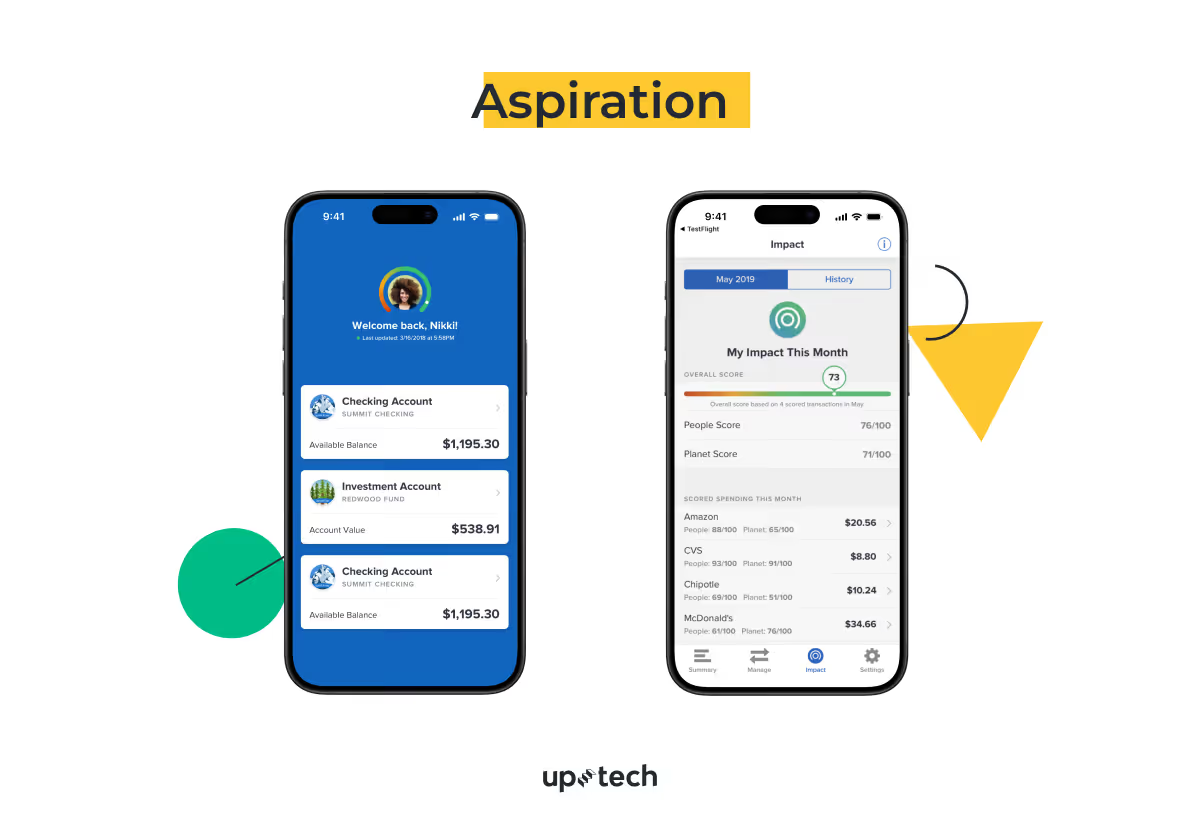
Aspiration is a financial app that supports charitable causes. Our team took the idea from scratch and turned it into an engaging app with active participation from the founders.
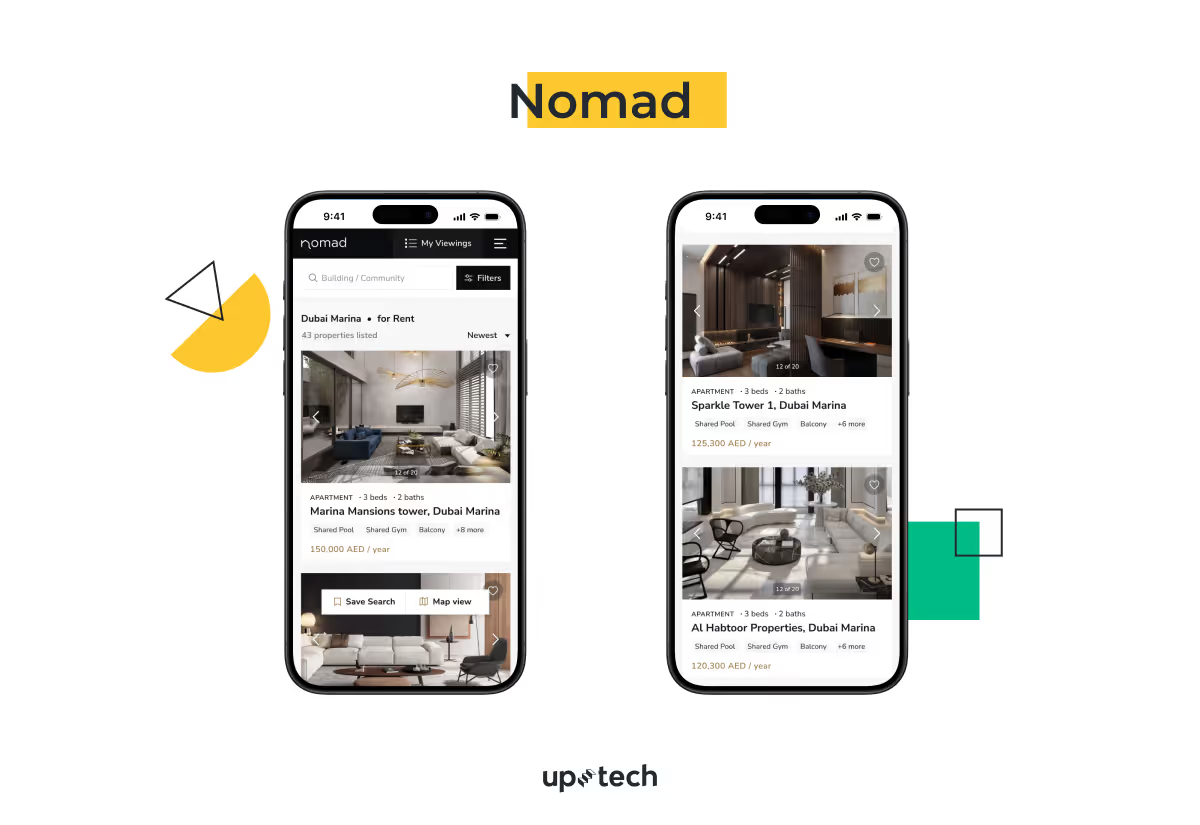
Nomad is a real estate app that provides a personalized house-buying experience. We helped Nomad’s team address customers' pain points with a visually pleasing and intuitive app.
Conclusion
Shortened time to market, rising costs, and talent scarcity are some challenges that companies must address to remain competitive in today’s business realities.
The Team as a Service model proves to be a reliable recruitment alternative for offloading software development needs to a trusted provider. We’ve shown you key considerations to take into account when choosing a TaaS provider.
We’re ready to clear your doubts and help you make the wisest choice.
Book a free consultation to explore how a dedicated TaaS team could support your next product milestone.






























.avif)